
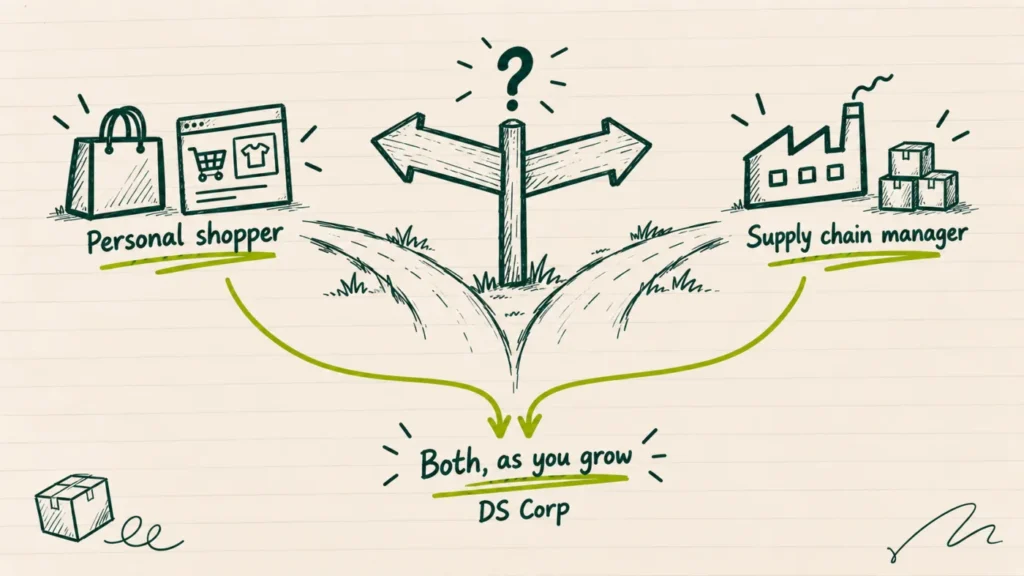
An India sourcing agent generally helps buyers find and evaluate suppliers or manufacturers — negotiating requirements, coordinating samples, and managing larger or recurring procurement. An India buying agent is generally more focused on purchasing a product the buyer has already found and moving it from India to the buyer’s destination. The two services overlap — some companies support both, depending on what you need. The right choice comes down to one question: do you already know what you want to buy, or do you need help finding who should supply it?
Key takeaways
- A buying agent is usually focused on purchasing an existing product for the buyer.
- A sourcing agent is generally more involved in finding suppliers or manufacturers.
- Buying agents suit marketplace purchases and smaller orders.
- Sourcing agents are often more relevant for bulk, recurring, or private-label requirements.
- Quality control and international shipping can be part of either service.
- The terms aren’t standardised, so always check what a company actually provides.
- Some businesses, including DS Corp, support both buying and sourcing requirements.
What is an India sourcing agent?
An India sourcing agent acts as a local sourcing partner for an international buyer. You may know what type of product you need but not which Indian manufacturers produce it, which suppliers are reliable, what MOQ is appropriate, how to compare suppliers, or how to coordinate procurement locally. A sourcing agent can potentially help with supplier identification, manufacturer discovery, product comparison, sample coordination, negotiation, procurement, quality control, packaging, and export coordination. The exact scope varies between companies.
What is an India buying agent?
A buying agent is generally focused on purchasing a product you’ve already identified. “I found this product on an Indian website, but the seller doesn’t ship to my country” is primarily a buying requirement — you might provide a product link, photograph, screenshot, product name, seller information, or description, and the buying agent handles the local purchase and may receive, inspect, and ship the product internationally. DS Corp describes itself as a buying desk rather than a store: you share a product link, image, or description, and the company purchases eligible products on your behalf, quality-checks them, and ships them internationally. Share a product link → get a quote
India sourcing agent vs buying agent
The easiest way to see the difference is to compare typical responsibilities.
| Requirement | Buying agent | Sourcing agent |
|---|---|---|
| Purchase an existing product | Strong fit | Possible |
| Buy from Indian marketplaces | Strong fit | Possible |
| Find manufacturers | Sometimes | Strong fit |
| Find new suppliers | Sometimes | Strong fit |
| Small personal purchases | Strong fit | Less common |
| Bulk procurement | Possible | Strong fit |
| Supplier negotiation | Sometimes | Common |
| Sample coordination | Possible | Common |
| Quality checks | Often available | Often available |
| Private label | Possible | Strong fit |
| Recurring procurement | Possible | Strong fit |
| Export coordination | Often available | Often available |
These are general distinctions, not universal rules. A company calling itself a “buying agent” may also offer sourcing services, and a “sourcing agent” may also handle individual purchases. Always evaluate the actual service rather than the label alone.
When should you use a buying agent?
A buying agent can make sense when you already know what product you want:
- Indian marketplace product — you found a product on an Indian marketplace but the seller only ships within India.
- Instagram seller — you see a product from an Indian Instagram seller but can’t purchase it directly from abroad.
- NRI shopping — you live outside India and want products that are easily available domestically.
- Small quantity — you need a few products rather than a full manufacturing run.
- Local Indian product — you want something from a local Indian shop that has no international storefront.
In these situations the main problem isn’t finding a manufacturer — it’s purchasing and moving the product internationally. That’s where a buying desk is useful.
When should you use a sourcing agent?
A sourcing agent generally becomes more valuable when the requirement is commercial and supplier-focused — for example, “I need an Indian manufacturer who can produce 10,000 units of this product every month.” That requires far more than purchasing an existing product: supplier discovery, manufacturer evaluation, MOQ, samples, product specifications, pricing, production capacity, quality control, packaging, recurring supply, and export coordination.
Buying agent vs sourcing agent for Amazon FBA
Amazon sellers can fall into either category. If you already found an existing product in India and want to purchase it, a buying-agent model may be appropriate. If you need hundreds or thousands of units, you may need a sourcing relationship with a manufacturer or wholesaler. If you want your own branding and packaging, manufacturer sourcing becomes more relevant, and if you need the same product every month or quarter, supplier selection and consistency matter more. So an Amazon seller shouldn’t ask “Do I need a sourcing agent?” — the better question is: do I need someone to buy an existing product, or do I need someone to find and manage a supplier? See FBA & reseller sourcing →
Buying agent vs sourcing agent for NRIs
NRIs often have a different requirement from commercial importers — clothing, food products, household products, cultural products, gifts, festival items, or something seen online in India. They may not need a manufacturer at all, just someone in India to purchase the product and arrange delivery. For that use case, a buying desk can be more appropriate than a traditional manufacturer-sourcing company. DS Corp’s NRI service is built around this type of international purchasing requirement and supports sourcing from Indian marketplaces and local sellers.
Buying agent vs sourcing agent for bulk importers
Bulk importers usually have more complex requirements — multiple suppliers, large quantities, consistent quality, product samples, production schedules, manufacturer relationships, packaging, export documentation, and freight coordination. In this situation, sourcing matters more than simply buying, and a bulk buyer may need to compare several manufacturers rather than purchasing from the first supplier found. DS Corp has a dedicated bulk-sourcing service for manufacturer and wholesaler sourcing, MOQ guidance, and batch-level quality checks. See bulk sourcing →
Do the two roles overlap?
Often, yes. A buyer may start with “please purchase this product for me,” and after a successful order the requirement may evolve into “can you find a manufacturer who can produce 2,000 units of this product?” The first is closer to buying; the second is closer to sourcing. A company capable of supporting both can continue working with you as the requirement grows. The reverse holds too — supplier discovery is often only the beginning, since someone still needs to place the order, coordinate production, check the goods, arrange packaging, prepare export documentation, and ship the products. Sourcing and buying can overlap significantly in a full-service relationship.
What should you look for in a sourcing or buying partner?
Don’t choose a partner only because their website uses the words “sourcing agent.” Ask practical questions instead:
- What exactly do they source? — marketplaces, local stores, wholesalers, manufacturers, or all of these?
- Can they work with your order size? — some companies focus on bulk procurement, others on individual purchases.
- Do they perform quality checks? — a visual inspection is different from laboratory testing, so understand what’s actually checked.
- Can they handle international shipping? — finding a supplier is only one part of the sourcing process.
- Can they provide clear quotations? — you should understand what you’re paying for.
- Can they support repeat orders? — this matters if you’re building a long-term supply chain.
- Can they work with your destination? — shipping requirements differ between countries. DS Corp currently lists regular shipping lanes including the USA, UK, UAE, Oman, New Zealand, South Africa, and several European destinations, while stating that unlisted destinations can be checked individually. See every country we ship to →
What does a good buying/sourcing process look like?
A transparent process should make each stage understandable. For an existing product, it can look like: share product → review → quote → approve & pay → purchase → quality check → export → delivery. DS Corp currently follows this workflow and provides tracking after dispatch. See how DS Corp’s process works →
For bulk sourcing, additional stages can apply: requirement → supplier discovery → samples → supplier evaluation → commercial negotiation → production → quality inspection → export → delivery. The exact workflow should be adapted to the buyer’s product and order.
What about quality control?
Quality control matters in both buying and sourcing. For a small purchase, you may simply want to confirm the correct product, correct quantity, visible condition, and packaging. For a commercial order, the process can involve sample comparison, specifications, batch quantity, packaging, labelling, production consistency, and specialist testing where required. DS Corp states that it physically checks orders against a checklist before dispatch and shares photographs with customers before shipment. For specialised products, determine whether independent testing or certification is needed in addition to a standard quality check. See our full QC process →
What about international shipping?
A sourcing relationship doesn’t end when the product is found — it still needs to move from India to the buyer. The appropriate method depends on weight, dimensions, quantity, destination, urgency, product category, and cost. For smaller shipments, courier or air shipping may be suitable; for larger commercial shipments, freight and sea shipping may make more sense. Evaluate the complete landed cost, not simply the supplier price.
Buying agent or sourcing agent: which one is right for you?
Use this as a starting guide, not a rigid rule.
Choose a buying agent when: you already know the product, you found it on an Indian marketplace, the seller doesn’t ship internationally, you need a smaller quantity, you want someone in India to purchase it, or you need local quality checking and shipping assistance.
Choose a sourcing agent when: you need to find suppliers or manufacturers, you need bulk quantities, you need private labelling or custom products, you need recurring procurement, or you need supplier management.
You may need both when a requirement starts as a product purchase but eventually becomes a recurring commercial sourcing relationship.
| Your requirement | Better starting point |
|---|---|
| One specific Indian product | Buying agent |
| Product from Amazon India | Buying agent |
| Product from Flipkart / Meesho | Buying agent |
| NRI personal purchase | Buying desk |
| Small reseller order | Buying or sourcing |
| Amazon FBA product test | Buying / sourcing |
| Bulk order | Sourcing agent |
| Manufacturer discovery | Sourcing agent |
| Private label | Sourcing / manufacturer |
| Recurring procurement | Sourcing partner |
The important word is starting point — your sourcing needs can change as your business grows.
How DS Corp fits into both models
DS Corp operates from Sangli, Maharashtra as a buying and sourcing desk. For individual and international buyers, it can purchase eligible products from Indian marketplaces and local sellers, receive them at its facility, quality-check them, and coordinate international delivery. For larger commercial requirements, it also provides bulk-sourcing support involving manufacturers and wholesalers, MOQ guidance, and batch-level quality checks. That means you don’t necessarily have to choose between a “buying company” and a “sourcing company” based on terminology alone — the more useful question is whether the partner can handle the sourcing problem you have today, and support the next stage if your requirement grows.
Frequently asked questions
What is an India sourcing agent?
An India sourcing agent helps international buyers identify suppliers or manufacturers in India and may assist with samples, negotiation, procurement, quality control, and export coordination.
What is an India buying agent?
An India buying agent purchases products on behalf of an international buyer and may handle local receiving, quality checks, consolidation, and international shipping.
What’s the difference between a buying agent and sourcing agent?
A buying agent is generally focused on purchasing an existing product, while a sourcing agent is more focused on finding and managing suppliers or manufacturers. The services can overlap.
Is an India buying agent useful for NRIs?
Yes. An India-based buying desk can be useful when an NRI wants products from Indian marketplaces or local sellers that don’t offer convenient international purchasing or shipping.
Is a sourcing agent useful for Amazon FBA?
It can be, particularly for bulk, private-label, recurring, or manufacturer-based sourcing requirements.
Can a buying agent purchase from Amazon India?
A buying service may be able to purchase eligible products from Amazon India on your behalf and coordinate international shipping, subject to product and destination restrictions.
Can a sourcing agent find manufacturers in India?
Yes. Manufacturer discovery is one of the common functions of commercial sourcing services.
Can one company provide both buying and sourcing?
Yes. Some India-based sourcing companies, including DS Corp, support both individual purchases and larger commercial sourcing requirements.
Do buying agents perform quality checks?
Some do. Always ask what’s included in the inspection, since a visual quality check is different from specialist testing or certification.
How do I choose an India sourcing partner?
Look at their sourcing channels, order-size capabilities, quality-control process, shipping support, destination coverage, communication, and transparency of quotations.
Final takeaway
The difference between an India sourcing agent and a buying agent mainly comes down to the problem you’re trying to solve. If you’ve already found a product and need someone in India to purchase and ship it internationally, a buying agent may be the more relevant starting point. If you need to discover suppliers or manufacturers, negotiate commercial requirements, or establish recurring procurement, a sourcing agent may be more appropriate — and for many businesses, the relationship eventually involves both. The best partner isn’t necessarily the one with the most impressive title; it’s the one that can clearly explain what it can source, what it can check, how it handles purchasing, how it manages shipping, and what happens when your requirement grows.
About DS Corp: DS Corp is an India-based buying and sourcing desk helping international buyers purchase eligible products from India, perform local quality checks, and coordinate international delivery. It also supports bulk-sourcing requirements for businesses looking for manufacturers and wholesalers. Share a product link → get a quote