
To buy Indian clothes from India while living abroad, confirm the seller’s measurements, stitching status, fabric description and included pieces before paying. Then check the return terms, shipping arrangements and timing for your destination. A familiar size label or an attractive outfit photograph is not enough to establish exactly what you will receive.
This matters whether you are choosing a kurta for everyday wear, a saree for a celebration or an outfit for a wedding. A few precise questions before purchase can be more useful than trying to correct an unsuitable order after it has travelled overseas.
What to confirm before you buy Indian clothes from India
Begin with the exact product and variant. Record the seller, colour, size, fabric description and the pieces included in the price. For a set, check each garment separately: the top may have measurements while the trousers are described only as free size.
Decide which details are essential and where you have flexibility. If you need a fully stitched blouse or a specific sleeve length, write that into the enquiry. Do not assume styling shown in a photograph is included in the sale.
DS Corp’s Fashion and Ethnic Wear service covers sourcing requests for Indian clothing. Share your requirements so the available product and any requested checks can be assessed before purchase.
Use measurements rather than a universal size conversion
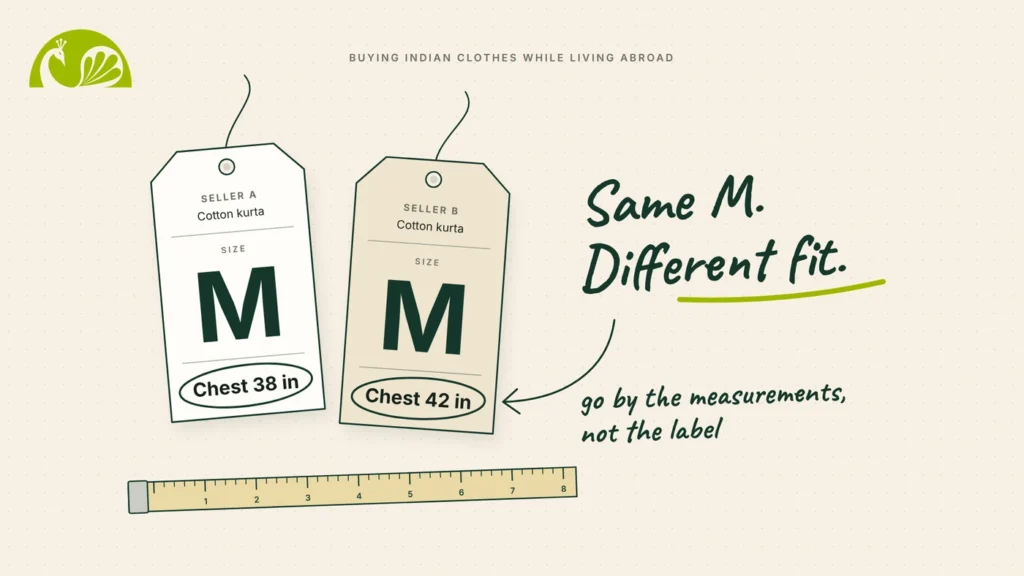
Use the size chart for the specific seller and garment. A medium from one brand may not match another, and a UK or US size does not establish the equivalent fit across Indian sellers.
First identify whether the chart gives body measurements or finished garment measurements. Those are different references. A garment needs an appropriate fit allowance, and the amount depends on its design, fabric and intended fit. Ask the seller to clarify an ambiguous chart rather than adding a fixed allowance yourself.
| Garment | Measurements or fit details to confirm |
|---|---|
| Kurta or tunic | Chest or bust reference, shoulder width, sleeve and overall length |
| Trousers or skirt | Waist reference, hip room, length and waistband construction |
| Blouse | Bust reference, shoulder, sleeve, length and closure |
| Lehenga outfit | Skirt waist and length, blouse sizing and included dupatta |
| Saree | Stated saree length and width, blouse-piece inclusion and any stitching service |
Measure in the same units used by the chart. Comparing a similar garment that already fits can help, provided you compare the same measurement points and account for differences in cut and stretch.
Know whether the clothing is stitched or unstitched
Descriptions such as ready to wear, semi-stitched and unstitched affect what work remains after delivery. Ask for the exact condition of the item rather than assuming every seller uses these terms identically.
| Description | What to establish before ordering |
|---|---|
| Ready to wear | The finished size, closures and any alterations you may still need |
| Semi-stitched | Which seams or parts remain unfinished and the available fitting range |
| Unstitched | Fabric quantities and pieces supplied, with tailoring arranged separately |
| Saree with blouse piece | Whether it includes fabric only or an actual stitched blouse |
A blouse piece shown with a saree should not be treated as a finished blouse unless the seller explicitly includes stitching. Similarly, do not assume DS Corp provides tailoring or alterations as part of a sourcing order. Confirm any additional service separately before relying on it.
Check fabric details and what the photographs show
Read the stated composition, lining, care instructions and embellishment details. Where a material claim is important to your choice, ask what documentation or label information supports it. A photograph or touch-based observation does not establish exact fibre composition or certification.
Screen settings and lighting can change how colour appears. If an outfit must match an existing garment, explain the reference and ask what comparison is feasible. A photograph can help communication, but it should not be treated as a guarantee of an exact colour match.
Check the list of included items. Belts, jewellery, footwear and styling accessories may be shown without being included. For sets, record the number of pieces and their individual details in the approved order.
Agree useful checks before international dispatch
Tell the sourcing team what you want checked while the item is still in India. For clothing, useful requests can include photographs, confirmation of the labelled size, accessible measurements, visible stitching condition and whether the supplied pieces match the order. Availability of additional checks should be agreed for the specific item.
The DS Corp inspection scope describes visible checks. They do not guarantee how a garment will fit your body, how it will wear over time or how its colour will behave after washing. Keep those limits separate from confirming that the correct item arrived.
Plan returns and event timing before buying
Check the seller’s conditions before ordering custom-sized, altered or made-to-order clothing. These orders may have different cancellation or return terms from standard stock. Read the DS Corp returns policy as well; a preference change after purchase should not be assumed to qualify for a return.
For a wedding or festival, allow for seller preparation, Indian delivery, agreed checks, export packing, international transport and customs. Leave practical time for any fitting work after arrival. Share the event date early and ask whether the plan is realistic; do not treat a domestic dispatch estimate as an overseas arrival promise.
Frequently asked questions
Can I order my usual UK or US clothing size?
Use the seller’s specific chart instead. Compare the stated measurements with your body or a similar garment that fits, and clarify whether the chart refers to the body or finished clothing. Size labels are not consistent across every brand.
Does a saree with a blouse piece include a stitched blouse?
Not necessarily. A blouse piece commonly refers to fabric supplied for tailoring. Check the product description and obtain written confirmation if you need a finished blouse or any stitching work included.
Can DS Corp send photographs or check measurements?
Its fashion service describes photographs and measurement requests as options to discuss. Specify what you need when submitting the product so the team can confirm the checks available for that order.
What if the colour looks different from the listing?
Ask for clarification before export if the received item appears materially different. Photographs can help assess a concern, but lighting and screens affect colour. Record any variation you agree to accept and confirm the applicable remedy if you do not accept it.
Can I be certain the outfit will arrive before a wedding?
No universal delivery guarantee is appropriate. Seller lead time, shipping and customs can vary. Give the event date before purchase and leave enough flexibility for delivery and fitting decisions.
Final takeaways
Buy the described garment, not the styling assumption. Verify measurements, stitching status, included pieces and seller terms, then plan the complete delivery journey. Clear requirements make the purchase easier to evaluate from abroad.
Share the outfit link, size information, destination and any event date through DS Corp’s Fashion and Ethnic Wear service to discuss sourcing.