Volumetric weight describes a parcel’s size in a form a courier can use when calculating charges. A lightweight box can occupy substantial transport space, so the scale weight alone may not determine its shipping cost. For services that compare actual and volumetric weight, the higher figure generally forms the chargeable-weight basis, subject to the service’s billing rules.
If you are buying from India, ask for the measurements of the packed parcel. A product described as weighing one kilogram may require a box and protection that change both its gross weight and its volume.
What volumetric weight measures
Actual weight comes from weighing the complete parcel, including its packaging. Volumetric weight comes from its external dimensions and the factor used by the selected service. Chargeable weight is the figure the carrier uses under its applicable pricing rules.
| Term | What it tells you |
|---|---|
| Actual weight | How much the packed parcel weighs on a scale |
| Volumetric weight | How much space the parcel occupies relative to the service’s calculation factor |
| Chargeable weight | The billing weight determined under the carrier’s rules |
These terms explain the weight basis, not the entire invoice. Destination, service level, surcharges and other shipment characteristics can still affect the amount payable.
How to calculate volumetric weight for a courier parcel
Multiply the parcel’s length, width and height, then divide by the divisor specified for the chosen service. Keep the units consistent. Using inches in a calculation intended for centimetres will produce the wrong answer.
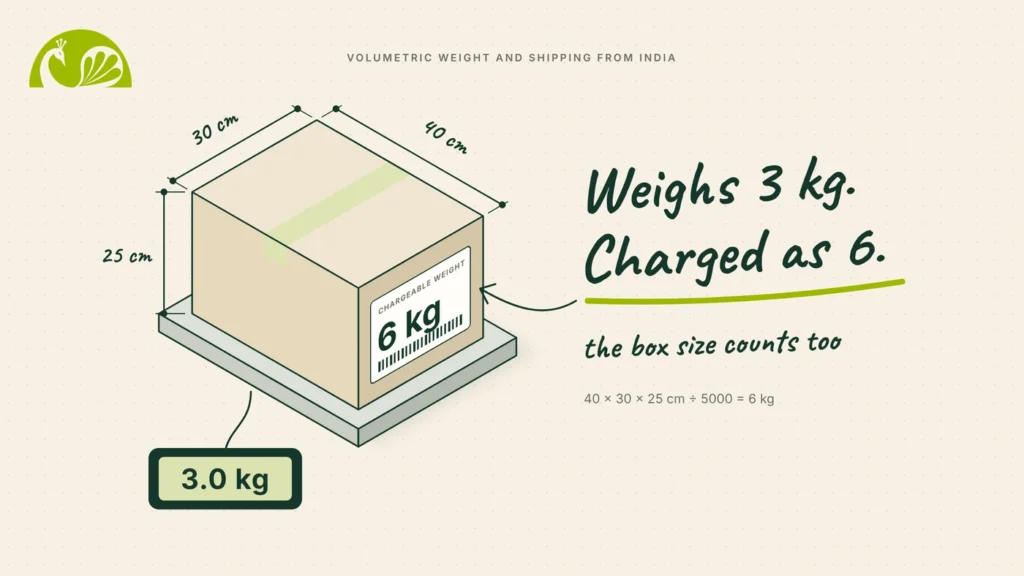
DHL Express publishes a calculation using dimensions in centimetres divided by 5000 to give kilograms. Under that example, a box measuring 40 cm by 30 cm by 25 cm has a volumetric weight of 6 kg: 40 multiplied by 30 multiplied by 25, divided by 5000.
If the parcel’s actual weight is 3 kg, the dimensional calculation is higher. Under that comparison, 6 kg is the weight basis before any applicable billing adjustments. Confirm the current divisor, measurement, rounding and minimum-charge rules for your selected service; do not apply this courier example automatically to every freight mode.
See how a different box changes the calculation
The following comparison is illustrative. It assumes a divisor of 5000 and the same 3 kg actual packed weight in both cases. A real packing change can also change actual weight and must be assessed for product protection.
| Parcel | External dimensions | Volumetric weight | Higher of actual and volumetric weight |
|---|---|---|---|
| Box A | 40 × 30 × 25 cm | 6 kg | 6 kg |
| Box B | 35 × 25 × 20 cm | 3.5 kg | 3.5 kg |
Box B occupies less space, so its calculated weight basis is lower under these assumptions. This does not establish an exact price saving: rate bands, minimums and other charges still matter. The smaller box is only a useful option if it can protect the actual item adequately.
Measure the parcel after packing
Use the external measurements of the finished parcel, not the dimensions printed in the product listing or the inside of an empty box. Include any bulging or projecting area as required by the carrier’s measurement rules. Weigh the parcel after adding protective material and closing it.
For several boxes, record the dimensions and actual weight of each one. Check whether the carrier calculates and rounds chargeable weight per piece before producing a shipment total. Averaging the dimensions or combining actual weights first may not reproduce the carrier’s calculation.
If packaging is provisional, label the measurements as estimates. Update the shipping assessment after the final packing arrangement is known rather than assuming a preliminary figure will remain unchanged.
Which purchases can be affected by parcel size
Boxed gifts, lightweight decor, clothing in presentation boxes and fragile craft items can occupy more space than their scale weight suggests. Protective packing may be essential even when it increases the calculated weight.
For example, a ceramic item might need space around it for cushioning. Removing that protection simply to make the box smaller can create a different problem. A dense item, by contrast, may remain chargeable by actual weight even after its box is reduced.
When comparing two product options, ask about the packed dimensions as well as the listed product weight. This is especially useful where packaging is unusually large relative to the contents.
When repacking may help
Repacking can sometimes reduce unused space, but it should be assessed alongside fragility, original packaging requirements and the condition you expect on arrival. Some retail boxes contain information or components you need to retain. Others may be important to a seller’s return conditions.
DS Corp’s shipping policy describes preparing orders for international transit. If parcel size is a concern, ask what packing options can be considered for your item and what trade-offs they involve. Do not assume the smallest box is suitable or that every repacking request reduces the price.
The quality-check process is another point to discuss any requirements for seals, accessories and packaging before dispatch.
Request a quote with usable shipment details
Provide the product link or description, quantity, destination country and postcode, and any available packed dimensions and weight. Say whether the original retail box must be retained and whether there is a required delivery date.
Ask which shipping service is being considered and whether the estimate is based on actual or dimensional weight. The DS Corp pricing explanation helps distinguish shipping from the other components of a buying order. For a particular route, such as the United States, the India-to-USA shipping guide covers the broader delivery process.
Frequently asked questions
Why is my light parcel quoted at a higher weight?
It may occupy enough space for volumetric weight to exceed actual weight. Ask for the packed dimensions, calculation factor and chargeable weight used. These details make the basis of the estimate easier to understand.
Do all couriers use a divisor of 5000?
Do not assume that. The applicable factor and measurement rules depend on the carrier and service. The 5000 divisor in this article is a DHL Express example, not a universal rule for every courier, airfreight or sea-freight shipment.
Should I calculate using the product dimensions or box dimensions?
Use the finished parcel’s external dimensions under the carrier’s rules. Product dimensions leave out the box and protective material, so they may understate the volume used for charging.
Will a smaller box always mean cheaper shipping?
No. Actual weight may still be higher, or both parcels may fall within the same charging band. Minimums and other fees can also apply. Any smaller packing arrangement must still be suitable for the product.
Can I estimate shipping from the product listing alone?
Sometimes you can obtain an initial estimate, but it depends on the information available. Ask whether the listed weight includes packaging and whether the dimensions describe the product or the finished parcel. Final packing may change the assessment.
Final takeaways
Measure the packed parcel, distinguish actual from volumetric weight and confirm the rules of the chosen service. Evaluate any smaller packing option against protection and the complete quote rather than assuming a lower calculated weight guarantees a particular saving.
Share your product, quantity and destination through DS Corp’s buying process to discuss an appropriate shipping assessment.