The landed cost of imports from India is the combined cost of buying goods and bringing them to your agreed destination. Depending on the order, it can include the goods, sourcing work, packing, transport, insurance, duties, taxes and clearance charges. Start by defining where the cost calculation ends and which charges are already included in each quote.
Choose the endpoint, such as your home or warehouse, before comparing offers. Quotes with different delivery scopes are not directly comparable.
What belongs in the landed cost of imports from India
Mark each cost as included, separately payable, not applicable or unconfirmed. A blank cell should not automatically mean zero.
| Cost group | Items to check |
|---|---|
| Goods | Agreed specification, quantity, unit price and currency |
| Sourcing and checks | Buying-service work and any separately agreed inspection |
| Preparation | Retail or export packing, repacking and documentation charges |
| Transport | Collection, domestic movement, international freight and final delivery |
| Protection | Insurance or other agreed cover, if purchased |
| Destination charges | Applicable duties, taxes, brokerage and clearance fees |
| Payment and other fees | Currency conversion, bank charges and relevant handling costs |
Some charges are bundled or paid to another provider. Ask what is covered before adding a fee; not every order has every line.
Gather the information before calculating
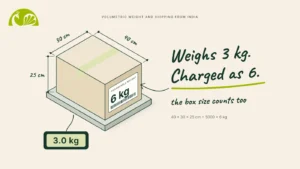
Record the specification, quantity, currency, destination and delivery scope. Add the package count, packed dimensions and gross weight. Packaging changes can alter freight charges even if the product quantity stays the same.
For business imports, discuss product classification and destination requirements with the relevant customs specialist. The fact that goods are purchased in India does not, by itself, establish their country of origin or eligibility for a trade preference.
Separate confirmed charges from estimates. Record quote validity, use one reporting currency and state the exchange rate used.
Build the total without counting the same charge twice
Add the product cost and each applicable cost not already included. Confirm the destination and delivery terms before comparing the result with another supplier’s offer.
DS Corp’s pricing and fees page explains the distinction between product cost, its service work and shipping. It also states that destination import duties and taxes are outside its quote. Include a separate allowance for applicable destination charges when planning your own budget.
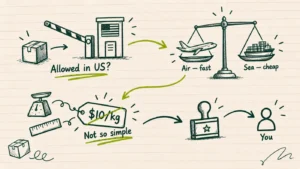
Ask the carrier or customs agent to confirm the actual assessment for your product and destination. Duty and tax calculations are not always a simple percentage of the product price, and an online estimate is not a customs decision. This guide provides a budgeting method rather than a country-specific tax calculation.
Work through an illustrative order
This example uses invented US-dollar amounts to demonstrate the calculation. It is not a DS Corp quote, a shipping rate or a statement of duty or tax rates.
| Example cost | Amount in USD |
|---|---|
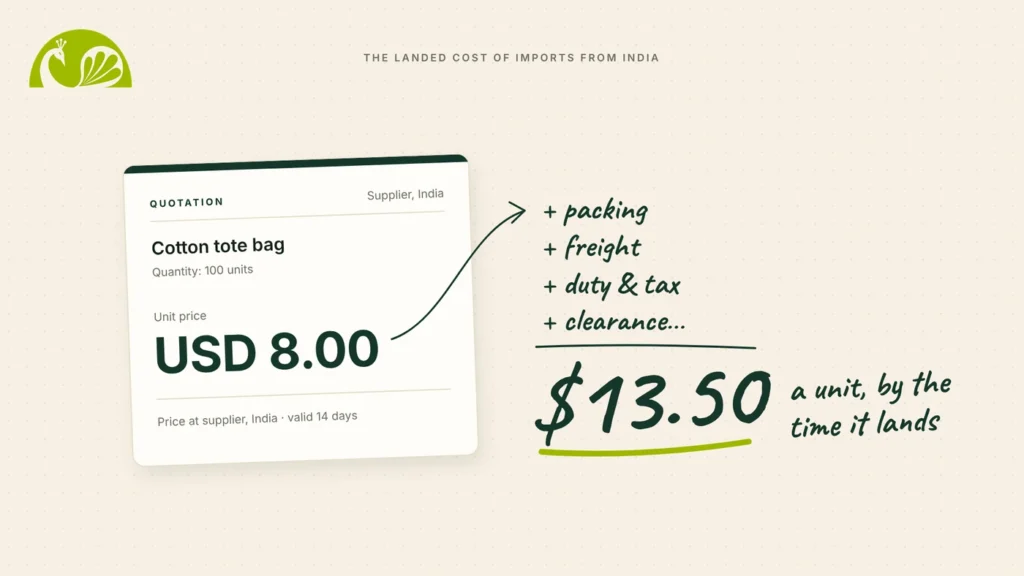
| 100 units at USD 8 each | 800 |
| Sourcing and inspection | 70 |
| Export packing | 50 |
| Domestic transport | 30 |
| International freight | 220 |
| Illustrative duty and import-tax allowance | 110 |
| Clearance and destination delivery | 45 |
| Payment and currency costs | 25 |
| Total estimated cash outlay | 1350 |
If all 100 units are saleable, the estimated cash outlay allocated to each unit is USD 13.50. The initial supplier price was USD 8 per unit, so using that price alone would leave USD 5.50 per unit of this example’s costs unaccounted for.
The example assumes separate charges and no purchased insurance. If import tax is recoverable, keep its cash payment in your funding plan and confirm its accounting treatment separately.
Calculate per-unit cost and selling costs separately
For a batch of identical items, divide the relevant total by the number of units available for sale. If only 95 units in the example were saleable and no costs were recovered, USD 1350 divided by 95 would be approximately USD 14.21 per saleable unit. This is an illustration of allocation, not an expected defect rate.
For mixed products, equal allocation may distort costs. Document a suitable basis for each charge, such as weight, volume or purchase value.
Landed cost excludes later selling expenses such as marketplace fees, advertising, storage and customer delivery. Include these when assessing profitability. Our India sourcing guide for FBA sellers covers the wider procurement process.
Compare quotations using the same assumptions
Compare equivalent specifications, quantities, endpoints and included work. Ask for exclusions: a lower unit price may come with different packing or a narrower delivery scope.
Record assumptions for unresolved charges. For Great Britain business orders, use the first-order UK importing checklist to plan responsibilities and paperwork.
Frequently asked questions
Is landed cost the same as international shipping cost?
No. Shipping is one component. Landed cost also includes the goods and other applicable costs needed to reach the agreed destination.
Are import duties included in a DS Corp quote?
DS Corp’s pricing page excludes destination import duties and taxes from its quote. Confirm the current breakdown and any amounts payable on arrival.
Should I include import VAT in the calculation?
Include payable tax in your cash-flow plan. Recovery eligibility and business accounting treatment depend on your circumstances and local rules; confirm them with your accountant.
Can the final landed cost change after I receive an estimate?
Yes. Quantity, packaging, exchange rates, service scope or destination assessment can change the total. Request an updated breakdown when the order changes.
How should I compare a small order with a larger order?
Compare both total cash required and cost per saleable unit. A cheaper unit price can still require more money upfront and leave more stock to sell. Use the MOQ guide when assessing quantity choices.
Final takeaways
Define the delivery endpoint, capture each applicable charge once and separate estimates from confirmed prices. Calculate the complete funding requirement before deciding whether the order makes sense at the intended quantity.
Send the specification, quantity and destination through DS Corp’s buying and sourcing process to request an order-specific cost breakdown.