Yes, international Amazon sellers can source products from India for Amazon FBA. The process usually means identifying a suitable product, finding an appropriate Indian supplier or manufacturer, evaluating samples and quality, confirming quantities and packaging, and arranging international shipping to the required destination. The exact process depends on the product, marketplace, order size, and import requirements. For smaller requirements, sellers may source existing products from Indian marketplaces; for larger or recurring orders, working directly with manufacturers or wholesalers is often more suitable.
Key takeaways
- India can be a sourcing market for Amazon sellers looking for existing or customised products.
- Marketplace sourcing and manufacturer sourcing are two different approaches.
- A product should be evaluated before committing to a large order.
- Samples help verify product quality and specifications.
- Quality control matters more as order quantities increase.
- Amazon FBA requirements should be considered before finalising packaging and shipping.
- Import regulations depend on the product and destination country.
- The cheapest supplier isn’t always the lowest-cost sourcing option after shipping, duties, and other expenses.
Why source products from India for Amazon FBA?
Amazon sellers can source from suppliers and manufacturers in many countries, and India is one option for a wide range of products — textiles, handicrafts, food products, spices, beauty and personal care, wellness, home products, traditional products, and selected industrial materials. The opportunity isn’t simply about finding something inexpensive. The better question is: can I find a product in India that meets my quality, demand, compliance, margin, and supply requirements? A product that looks attractive at the supplier’s price can become unprofitable once international shipping, import costs, Amazon fees, and packaging are included.
What types of products can Amazon sellers source from India?
The right product depends on your marketplace, target customer, competition, and regulatory requirements. Potential categories include:
- Textiles and apparel — ethnic clothing, fabrics, home textiles, accessories, and selected fashion products.
- Handicrafts — home décor, decorative products, gifting products, traditional crafts, and handmade goods.
- Food and spices — spices, packaged foods, and ingredients, with close attention to food regulations, labelling, and import requirements in your target market.
- Beauty and personal care — a large market, but verify the applicable regulatory and marketplace requirements before importing and selling.
- Wellness and Ayurveda — distinguish between general consumer products and products subject to health, safety, labelling, or regulatory requirements.
- Raw materials — India may also be a source of ingredients or raw materials rather than finished consumer products.
DS Corp sources across food, spices, beauty, Ayurveda, fashion, handicrafts, pooja products, and raw materials. See our product categories →
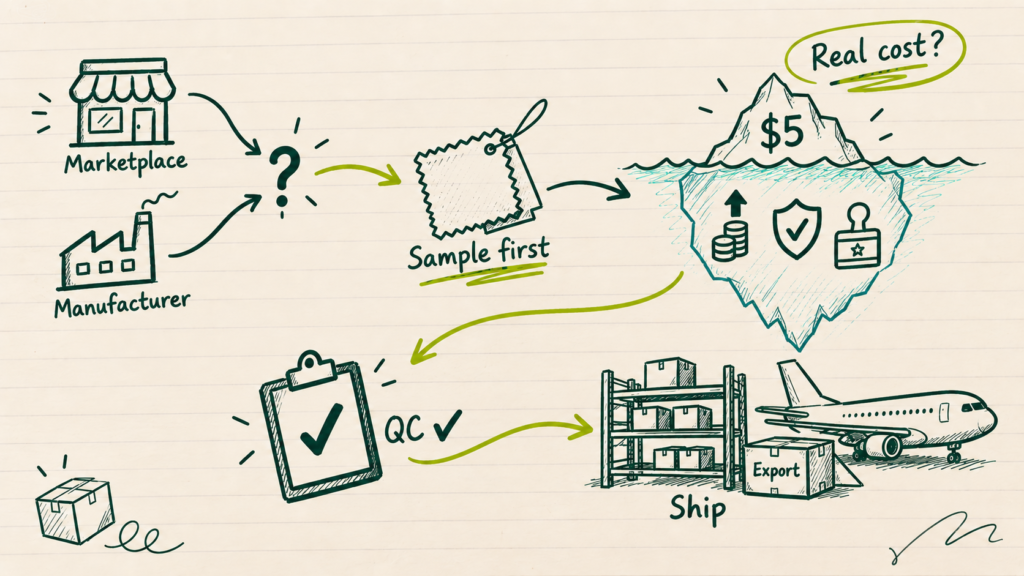
Marketplace sourcing vs manufacturer sourcing
One of the first decisions is where the product should be sourced from.
Marketplace sourcing
You identify an existing product on an Indian marketplace and buy it. This is useful when testing a product, buying smaller quantities, validating demand, or sourcing an already-developed product. The advantage is simplicity. The disadvantage is limited control over product specifications, branding, packaging, MOQ, consistency, and long-term supply.
Manufacturer sourcing
You work directly with an Indian manufacturer. This makes more sense for bulk orders, private-label products, custom products, recurring orders, larger businesses, and long-term supply relationships. The manufacturer may be able to customise specifications, packaging, branding, materials, quantities, and production requirements — but manufacturer sourcing generally requires more supplier research and coordination.
Which sourcing method is better for Amazon FBA?
Neither is automatically better — it depends on where you are in your business. If you’re testing a product, marketplace sourcing may be simpler. If you need 5,000 units, manufacturer sourcing may make more sense. If you want your own brand, look for manufacturers that support private-label requirements. If you already have a proven product, a direct supplier relationship helps with recurring procurement. If you found one specific product online, a buying desk can help you purchase the existing product first. Match the sourcing method to the business requirement.
Step 1: Define your product requirement
Before contacting suppliers, clearly define the product — product type, material, size, colour, weight, quantity, packaging, target market, intended selling price, required specifications, and branding requirements. If you’re sourcing an existing product, give the supplier a product link, image, model number, description, or specification sheet. Clear requirements reduce misunderstandings later.
Step 2: Research the Amazon market
Finding a supplier shouldn’t be your first step. First understand whether the product makes commercial sense. Research demand (are customers actually looking for it?), competition (how many established sellers?), selling price (what are comparable products selling for?), reviews (what complaints or unmet needs recur?), and differentiation (can your product offer something meaningfully different — better packaging, different material, improved design, additional features, better size options, or a more specific target audience?). The objective isn’t to copy an existing listing; it’s to identify a viable product opportunity.
Step 3: Find potential Indian suppliers
Once the requirement is clear, identify potential sourcing channels — manufacturers, wholesalers, Indian marketplaces, distributors, specialist suppliers, local businesses, and sourcing companies. Local sourcing support is useful when the supplier is difficult to identify or communicate with. DS Corp’s model can begin with a product link, image, or description and can extend to marketplace, local-seller, and bulk sourcing. See how DS Corp’s sourcing process works →
Step 4: Evaluate the supplier
Don’t choose a supplier on the first price you receive. Evaluate product expertise (do they actually specialise in the product?), capacity (can they supply your expected quantity?), MOQ, quality consistency across batches, communication, samples, packaging capability, and documentation for the product and destination. A supplier that fits your business requirements can be more valuable than the one offering the lowest initial quote.
Step 5: Request and evaluate samples
A sample lets you assess the product before committing to a large purchase. Depending on the category, evaluate material, size, weight, colour, finish, functionality, packaging, labelling, and product consistency. For private-label products, also evaluate logo placement, packaging design, branding, inserts, and presentation. Keep a record of the approved sample — it becomes a reference when evaluating the production batch.
Step 6: Calculate your landed cost
This is one of the most important calculations in international sourcing. Don’t evaluate a product on its Indian supplier price alone. Your landed cost can include the product cost plus sourcing/procurement costs, packaging, domestic transportation, quality inspection, international shipping, customs duties and taxes, and other import or destination charges. Then factor in your Amazon-related expenses and other business costs. A product that costs $5 from a supplier isn’t a $5 product by the time it reaches your Amazon fulfilment network. Evaluate the final economics before placing a large order.
Step 7: Plan Amazon FBA packaging and labelling
Amazon fulfilment requirements should be considered before the product ships. Depending on the marketplace and product, you may need to consider product labels, barcodes, packaging, carton requirements, product preparation, shipment configuration, and other Amazon-specific requirements. These can change and vary by marketplace and category, so always verify the current requirements directly with Amazon before finalising a commercial shipment — especially when products ship directly from India to an Amazon fulfilment location.
Step 8: Quality control before export
Quality control is especially important when the buyer is outside India and can’t inspect the products in person. A pre-shipment quality check helps identify obvious issues such as incorrect product, incorrect quantity, visible damage, packaging problems, missing components, obvious defects, or differences from the approved sample. For larger orders, the inspection process can be more structured. DS Corp’s quality check covers the product against the order, quantity, visible condition, and packaging, and photographs the order before dispatch. A visual quality check doesn’t replace specialist testing where a product requires laboratory or regulatory testing. See our QC process →
Step 9: Decide how to ship to Amazon FBA
Once the product is sourced and checked, decide how it reaches its destination. The right method depends on order size, weight, dimensions, urgency, destination, product type, and total cost. Air freight can suit smaller or time-sensitive shipments. Sea freight can suit larger commercial shipments where lower transport cost matters more than speed. Courier can be convenient for certain smaller eligible shipments. The objective isn’t the cheapest method — it’s the right balance of cost, speed, reliability, and product requirements.
Step 10: Understand import requirements
Before importing for Amazon FBA, understand the destination country’s requirements — customs classification, duties, taxes, product standards, labelling, safety requirements, certifications, documentation, and restricted-product rules. This matters especially for food, cosmetics, supplements, wellness products, agricultural products, chemicals, children’s products, and other regulated categories. An Indian supplier may sell a product domestically without the same requirements that apply when it enters another country. Always verify destination-country requirements before placing a large order. See customs and duties by country →
How to source from Indian marketplaces for Amazon FBA
You don’t always need to begin with a manufacturer — sometimes the product already exists on Amazon India, Flipkart, Meesho, Instagram, a local Indian store, or an Indian brand website. If the seller only delivers domestically, an India-based buying desk can buy the product locally and coordinate its international shipment. DS Corp supports sourcing from Amazon India, Flipkart, Meesho, Instagram sellers, and local Indian stores. This can be useful for testing an existing product before exploring a larger supplier or manufacturer relationship.
When should you move from marketplace to manufacturer?
A marketplace is useful during discovery or testing. If the business starts generating consistent demand, the sourcing strategy may need to evolve. Consider moving toward a manufacturer when you need larger quantities, lower per-unit costs, consistent supply, private labelling, custom specifications, custom packaging, or recurring production. A typical progression: product discovery → sample → small test order → market validation → larger procurement → manufacturer relationship. It isn’t the only path, but it reduces the risk of committing to a large supplier relationship before understanding the product.
Private label sourcing from India
India can also be considered for private-label products, where a manufacturer produces a product sold under your own brand. Potential requirements include product specifications, packaging, branding, labelling, minimum order quantities, samples, quality standards, and production timelines. Private-label sourcing generally requires more supplier coordination than buying an existing retail product. Before proceeding, confirm the manufacturer can consistently meet the required specifications and that the product complies with the destination marketplace and country’s requirements. See our white label service →
What should Amazon sellers ask an Indian supplier?
- Product — what materials are used; exact dimensions; product weight; whether specifications are consistent between batches.
- Quantity — the MOQ; whether they can supply larger quantities; whether they support recurring orders.
- Quality — whether they can provide a sample; what quality checks are performed; whether the final order can be inspected before shipment.
- Packaging — whether packaging can be customised; whether product labels can be added; whether packaging can meet destination requirements.
- Commercial — the unit price; payment terms; what additional costs to consider.
- Logistics — whether they support export documentation; where goods can be shipped; what shipping methods are available.
The objective is to understand the complete sourcing process, not just negotiate the lowest unit price.
Common mistakes Amazon sellers make when sourcing from India
- Choosing the cheapest supplier — the cheapest product price doesn’t necessarily produce the lowest landed cost.
- Ordering too much before testing — a large order creates more risk if the product underperforms.
- Skipping samples — a photograph isn’t a substitute for physically evaluating a sample.
- Ignoring packaging — packaging affects both product condition and marketplace requirements.
- Forgetting import requirements — destination regulations should be understood before shipment.
- Not defining quality standards — “good quality” means different things to different people; specific requirements are better.
- Focusing only on supplier price — the real number is the total cost of getting a compliant, sellable product into your fulfilment network.
A practical Amazon FBA sourcing checklist
- Product research — demand researched; competition reviewed; customer complaints analysed; differentiation identified.
- Supplier — supplier information checked; product capability confirmed; MOQ understood; production capacity discussed.
- Sample — sample received; specifications checked; quality reviewed; packaging reviewed.
- Commercial — unit cost confirmed; sourcing costs understood; shipping estimated; duties/taxes considered; landed cost calculated.
- FBA — Amazon requirements checked; labels confirmed; packaging requirements checked; shipment destination confirmed.
- Quality — inspection requirements defined; quantity verified; product condition checked; final order compared with requirements.
Frequently asked questions
Can I source products from India for Amazon FBA?
Yes. Amazon sellers can source eligible products from Indian marketplaces, wholesalers, suppliers, or manufacturers and arrange shipment to their target market or fulfilment network, subject to Amazon’s requirements and applicable import regulations.
Is India a good country for Amazon FBA sourcing?
India can be a sourcing option because of its diverse supplier and manufacturing ecosystem. Whether it’s suitable depends on the product, quality, demand, landed cost, competition, and destination-market requirements.
Can I source products from Amazon India for Amazon FBA?
Potentially. Existing products can sometimes be purchased from Indian marketplaces and shipped internationally, but you must consider product rights, marketplace policies, import requirements, labelling, and other applicable rules.
Can I find Indian manufacturers for Amazon FBA products?
Yes. Indian manufacturers can be considered for bulk, private-label, and custom-product requirements. Evaluate the supplier for product capability, quality, MOQ, capacity, and compliance requirements.
Should I use a sourcing agent for Amazon FBA?
A sourcing agent can help when you need support finding suppliers, communicating with Indian businesses, checking products, or coordinating procurement and shipping. The value depends on your order size and how much of the process you want to manage yourself.
What is the minimum order quantity for Indian suppliers?
There’s no universal MOQ. It varies by supplier, product, manufacturing process, and whether the order is retail, wholesale, or private label.
Can products sourced from India be shipped directly to Amazon FBA?
Depending on the product, destination, and fulfilment requirements, products can potentially be shipped into an Amazon fulfilment network. You need to meet Amazon’s current packaging, labelling, shipment, and marketplace requirements.
How do I check the quality of products sourced from India?
Start with clear specifications and a sample. For larger orders, establish an inspection checklist and consider a pre-shipment quality check. Specialised products may require independent testing or certification.
Is sourcing from India cheaper than sourcing from other countries?
There’s no universal answer. Compare the complete landed cost — product price, packaging, sourcing, shipping, customs, taxes, and other expenses — rather than supplier prices alone.
Can I source private-label products from India?
Yes, depending on the product and manufacturer. Private-label sourcing generally requires agreement on specifications, branding, packaging, MOQ, quality, and production requirements.
Final takeaway
Sourcing products from India for Amazon FBA isn’t simply about finding an Indian supplier with a low price. A successful process connects product research, supplier selection, samples, quality control, packaging, shipping, import requirements, and Amazon’s fulfilment requirements. For a seller testing an existing product, an Indian marketplace can be a practical starting point; for larger or recurring orders, working directly with a manufacturer or wholesaler can give more control over supply, specifications, and packaging. Whatever model you choose, start small where appropriate, document your requirements, evaluate the supplier carefully, and calculate the complete landed cost before committing to a large order. For international sellers without an established network in India, a local sourcing partner can provide on-ground support with product purchasing, supplier coordination, quality checks, and international shipping.
About DS Corp: DS Corp is an India-based sourcing and buying desk supporting international buyers, resellers, and Amazon FBA businesses with product sourcing from India. Its services include marketplace sourcing, bulk sourcing, quality checks, and international shipping coordination. Explore FBA & reseller sourcing →