A supplier’s minimum order quantity, or MOQ, is the smallest quantity it will accept under a particular product specification and commercial offer. When sourcing from India, the minimum can vary by supplier, product, colour, design and packaging. Ask exactly what the MOQ applies to before comparing quotations.
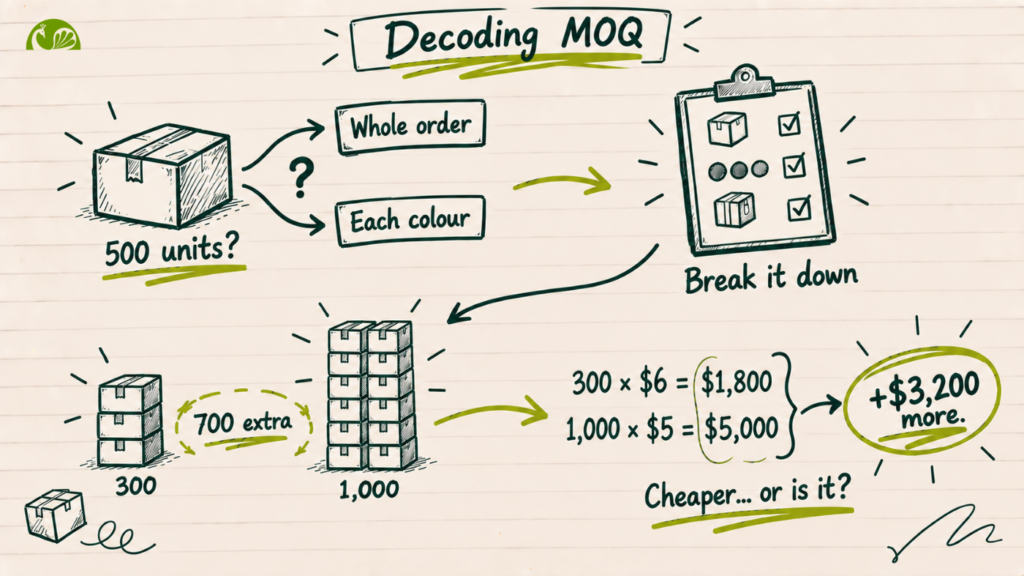
An offer for 500 units can mean 500 units across the whole order or 500 units of each colour. A product might also have a lower minimum than its custom printed box. These details change how much stock you buy and how much money the first order requires.
There is no single MOQ for all Indian suppliers. The useful question is whether the minimum for your chosen specification fits a commercially sensible first order.
Separate the different minimum quantities
Ask the supplier to break down the offer before negotiating the headline number. Use the same breakdown when comparing alternatives.
| Minimum | Question to ask |
|---|---|
| Product | Is this quantity for the whole order or one product model? |
| Colour or design | Can I combine variants to reach the total, or does each need its own minimum? |
| Material | Does the chosen fabric, component or finish require a separate purchase minimum? |
| Branding | Does adding my logo change the product minimum or create a setup charge? |
| Packaging | Are printed boxes, labels and inserts subject to separate minimums? |
| Repeat order | Will the same minimum and setup charges apply when I reorder? |
Consider an illustrative order for four colours. If the minimum is 500 units per colour, the total is 2,000 units. If the supplier accepts 500 units across all four colours, it is a different proposal. Neither interpretation should be left to assumption.
Understand why the supplier has set that minimum
Ask which part of the order creates the constraint. A supplier may need to buy a material batch, prepare equipment, develop a sample or pay a packaging printer. The explanation helps you identify which changes could make a smaller order feasible.
An available stock product may have different minimums from a product made to your specification. Adding a custom colour, unusual size or new material can change the production requirement. Treat the MOQ as part of the complete offer, alongside the specification, unit price and lead time.
For branded goods, ask whether you are selecting an existing product for your label or requesting product development. Supplier terminology varies, so write down the exact changes you want. Our white label and packaging service starts by reviewing the product, quantity and branding requirements.
Compare lower quantity options before reducing quality
A lower MOQ may be possible if you simplify the order. Ask the supplier to quote a few practical alternatives using the same essential quality requirements.
- Use an existing product specification or available material, if it meets your needs.
- Launch fewer colours or sizes so the first order is concentrated in fewer variants.
- Ask whether standard packaging with an approved label is feasible instead of a custom printed box.
- Request a paid pilot run and ask which setup costs make its unit price different.
- Compare suitable wholesale stock with custom production when you do not need an exclusive design.
These are options to explore, not terms every supplier will offer. Record any change to the product or packaging so that a lower quote does not quietly become a different specification. Confirm that proposed labelling and packaging remain suitable for your destination and sales channel.
Check whether packaging creates excess stock
Suppose a supplier can provide 300 products but the selected printer requires 1,000 boxes. If you proceed on that basis, 700 boxes remain after packing the first batch. Those figures are an example, not a standard MOQ or a DS Corp quotation.
Before approving the order, ask who owns the unused packaging, where it will be kept, whether storage has a cost and what happens if the artwork changes. Also ask whether a smaller print run or a different packaging format is available.
A commitment to buy materials now and take delivery in stages can change cash requirements and storage responsibilities. Treat it as a separate commercial agreement. Future deliveries still need clear specifications, dates and conditions.
Custom packaging is usually where a minimum-quantity mismatch shows up first. Before committing to a print run, it helps to prepare the packaging brief so the pack size, artwork and quantity are agreed together, not worked out after the fact.
Compare the total commitment at each quantity
A lower unit price can require substantially more inventory. Compare both the delivered cost per unit and the total amount you must commit. Include setup, samples, packaging, sourcing support, inspection, transport and applicable destination charges when estimating the order.
For example, 300 units at an illustrative product price of USD 6 cost USD 1,800. An offer of 1,000 units at USD 5 costs USD 5,000 before any other charges. The larger order saves USD 1 on the product price per unit but requires USD 3,200 more for the products alone.
Decide whether the extra stock fits your demand evidence, available storage and reorder plan. Ask for comparable quotations with the same delivery scope and check which costs are estimates. You can review how DS Corp pricing works before requesting an order-specific quote.
Send an enquiry that a supplier can quote accurately
A question such as ‘What is your lowest MOQ?’ gives a supplier little information. Send the product reference and explain your preferred first order. The following wording can be adapted for a supplier enquiry.
“We are sourcing [product] for sale in [destination country]. Our proposed first order is [quantity], split into [quantity by colour or design]. The required material and dimensions are [specification], with [branding and packaging]. Please quote your minimum for the product, each variant and each packaging component separately. Include sample costs, setup charges, production lead time and delivery scope. Please also quote a simpler packaging or smaller trial option if available.”
Attach a reference image or specification sheet. If you have a target budget, state whether it is for the goods alone or the delivered order. This avoids comparing a factory price with a budget that must also cover shipping and import costs.
Include the checks you expect before dispatch in that discussion. Our pre-shipment inspection checklist can help you define the scope before accepting the quote.
Frequently asked questions
What is the normal MOQ for Indian manufacturers?
There is no universal number. Request a minimum for your exact product, material, variants and packaging. Confirm whether that minimum applies per item, per colour or to the complete order.
Can I order samples below the production MOQ?
Ask the supplier. A sample may be available separately, with its own price and delivery cost. Receiving one does not mean the supplier will accept the same small quantity for production or offer the sample at the eventual bulk unit price.
Is a low MOQ always the best choice?
A smaller order can reduce your initial stock commitment, but compare the specification, consistency, unit cost and availability for repeat orders. A low minimum has limited value if the product does not suit your customers.
Can DS Corp confirm a minimum before I commit?
Our bulk sourcing service includes MOQ guidance based on the product and supplier. Share your quantity and requirements so we can review feasibility. Minimums and charges are confirmed for the individual enquiry.
Ask for a quote for your first order
Send DS Corp your product link or reference, quantity by variant, packaging needs and destination through our sourcing quote form. Tell us whether you want available stock, your own branding or a custom specification. That gives us the information needed to discuss a realistic first order.