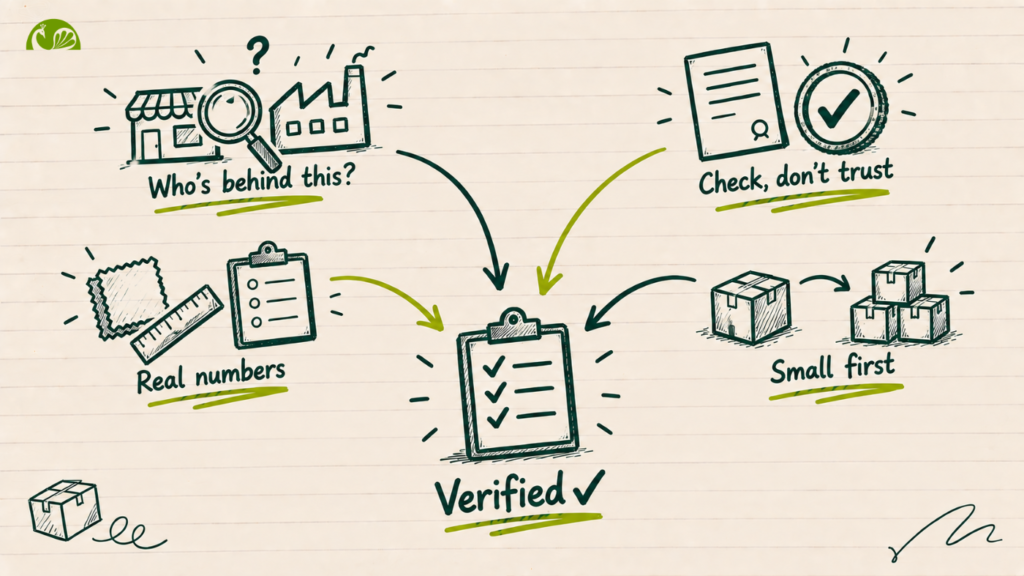
To verify an Indian supplier before a bulk order, confirm the business behind the quotation, check the exporter’s IEC details where applicable, evaluate a sample against written specifications, and agree how production quality will be checked. Registration helps establish identity; you also need evidence that the supplier can fulfil your particular order.
For an overseas buyer, the difficult part is connecting what a supplier says with what you can verify from a distance. A catalogue can show an attractive product. It tells you much less about who will manufacture it, whether the same specification can be repeated, or what happens if the finished batch has problems.
Work through the checks below before approving the first production order. Keep the evidence with your quotation and purchase order so that later decisions refer to the same information.
Confirm which business will supply your order
Ask for the supplier’s legal business name, trading name, registered address, operating address and the name of the person responsible for your order. Establish whether you are speaking with a manufacturer, wholesaler, merchant exporter or sourcing intermediary.
A trading business can be a suitable supplier. What matters is knowing its role and who controls production, packing and dispatch. If the quotation comes from one business and the payment request names another, ask for the relationship to be explained and documented before proceeding.
If you need help deciding which kind of local partner fits your requirement, read our guide to India sourcing agents and buying agents.
Check registration details against official records
Request the registrations relevant to the business and the transaction, such as its GST details where applicable. Check supplied identifiers with the issuing authority rather than relying only on a certificate image. Compare the business names and ask for an explanation of any differences.
If the supplier will export the goods, ask which entity will act as the exporter and request its Importer Exporter Code, or IEC. The DGFT View IEC Related Details service provides a way to view basic IEC details, including Denied Entity List status, using the IEC and the beginning of the firm’s name.
Treat these checks as evidence of identity and registration. They do not establish production quality, confirm ownership of a factory or guarantee delivery. A local manufacturer may also work through a separate exporter; document both parties’ responsibilities when that is the proposed arrangement.
Ask for evidence of the capability your order needs
Make the conversation specific to your product. A supplier who can provide a standard item may need different equipment or subcontractors for your material, finish or packaging. Ask which operations happen in-house, which are outsourced, and where the goods will be inspected.
Request examples of comparable products and ask how the supplier plans to meet your quantity and dispatch date. A live walkthrough or an independently arranged site visit can help you understand operations. Neither replaces a product sample or a written production plan.
- Can you make this specification using the proposed material and process?
- What quantity can you commit to for this order, given your existing workload?
- Which materials or components must be bought before production starts?
- Who will manage rework if the finished goods differ from the approved specification?
- Can you provide a reference for a comparable order, with that customer’s permission?
Look for answers that describe a workable process. A general claim about monthly capacity is less useful than an explanation of when your materials will arrive and when your production slot is available.
If your order is a raw material or ingredient rather than a finished product, capability questions are best grounded in a written spec. Our guide on how to define your material specification covers what to include before you ask a supplier to confirm they can meet it.
Approve a sample with measurable specifications
Evaluate the sample against a written brief. Record dimensions, material requirements, colour references, finish, packaging and any performance criteria that matter to your customer. Decide which characteristics you can inspect visually and which require a separate test.
For example, a textile buyer might record the agreed finished dimensions and seam construction. A home decor buyer might document the finish, stability and acceptable handmade variation. These requirements need to suit the actual product; a generic checklist cannot define them for every category.
Identify the approved sample with a date and version reference, and record any changes required before production. Ask the supplier to acknowledge the same specification. If the material or production method changes later, review whether another sample is needed.
An approved sample establishes a reference for the order. To check consistency, agree how the production batch will be compared with that reference before it leaves India.
Put the commercial agreement in writing
Ask for a quotation that identifies the product, specification version, quantity by variant, unit price, currency and validity period. It should explain packaging, production lead time, delivery scope and costs that are excluded. Agree payment milestones and the process for handling shortages or goods that fail the agreed checks.
Confirm who will arrange inspection, who can approve dispatch and what evidence you will receive. If payment details change, verify the change through a contact you have independently confirmed before sending money.
Check whether the minimum applies to the whole order or each variant. Our guide to minimum order quantities in India explains how to compare those terms.
For sourcing support, our bulk sourcing service covers manufacturer and wholesaler sourcing, MOQ guidance and order coordination. The scope and pricing depend on the product and work involved.
Use the first order to test repeatability
Where commercially feasible, agree a smaller initial order that uses the intended production specification. Define what you want to learn from it: consistency across units, packaging suitability, documentation accuracy or the supplier’s ability to meet the agreed schedule.
Record the result before increasing the quantity. A successful sample and a successful production order answer different questions. Keep the specification current for repeat orders, especially when changing colours, materials, packaging or the manufacturing location.
Keep a supplier verification record
Use this simple record when comparing suppliers. Mark unanswered points as pending so that missing evidence stays visible.
| Check | Evidence to retain |
|---|---|
| Business identity | Legal and trading names, addresses and relevant registration checks |
| Supply arrangement | Manufacturer, seller and exporter roles for this order |
| Production capability | Comparable products, capacity discussion and agreed schedule |
| Product approval | Sample reference, specification version and approved changes |
| Order terms | Quotation, payment milestones and process for rejected goods |
| Dispatch decision | Inspection scope, required evidence and person who approves release |
Frequently asked questions
Does an IEC prove that a supplier is reliable?
An IEC check helps verify exporter details. It does not prove that a supplier can manufacture your product consistently or meet your delivery schedule. Assess capability, samples and order terms separately.
Can I verify a supplier without travelling to India?
You can begin with official records, document checks, samples, video discussions and references. For an order that needs physical verification, agree a local visit or inspection with an appropriate provider and specify the evidence you need.
Is a manufacturer always better than a wholesaler?
The right choice depends on your requirements. A wholesaler may suit an available product and smaller quantity. A manufacturer may suit custom specifications or repeat production. Evaluate the actual offer, including traceability and responsibility for quality.
Discuss your sourcing requirement with DS Corp
DS Corp is an India-based buying and sourcing desk in Sangli, Maharashtra. Send your product reference, intended quantity, destination and required delivery date through our bulk sourcing enquiry form. Include any supplier details you already have and the checks you need so we can discuss a suitable scope of support.